
What is Vector Processing?
(Vector Processing क्या है?)
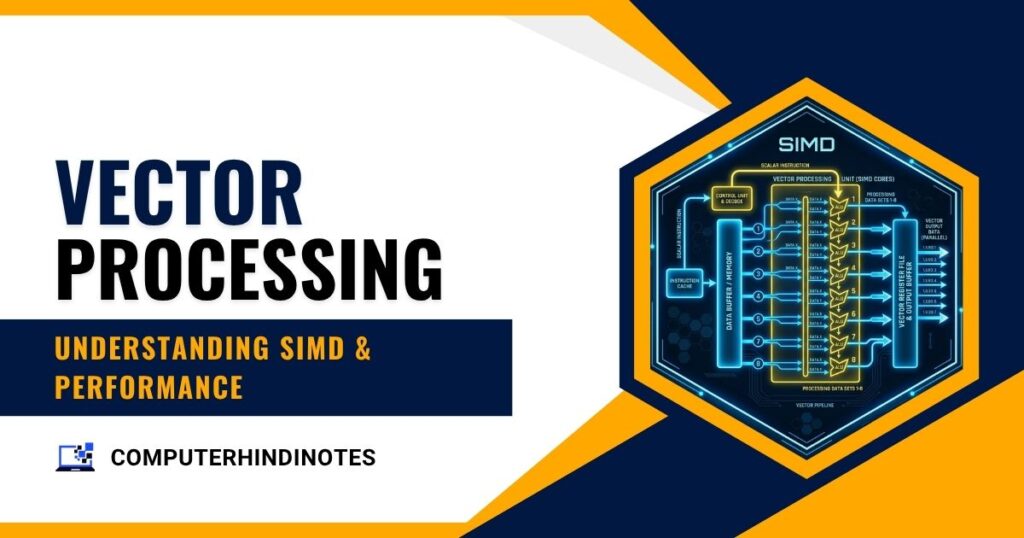
Vector Processing एक advanced computer architecture technique है, जिसमें एक ही instruction की मदद से कई data elements पर एक साथ (simultaneously) operation किया जा सकता है।
Table of Contents
ToggleScalar processors सिर्फ एक data value पर काम करते हैं, लेकिन Vector Processing में data को vector या array के रूप में store किया जाता है, और processor पूरे vector पर simultaneously calculation कर सकता है।
इसका मुख्य फायदा यह है, कि large mathematical और scientific calculations बहुत तेजी से पूरी हो जाती हैं। इसलिए यह तकनीक उन applications में extensively उपयोग होती है, जहाँ high-speed computation चाहिए, जैसे weather forecasting, image processing, artificial intelligence और supercomputers।
Key Points
- एक instruction कई data elements पर एक साथ apply होती है।
- यह SIMD (Single Instruction Multiple Data) principle पर आधारित है।
- Data सामान्यतः vector या array form में store किया जाता है।
- Large calculations के लिए high-speed performance देती है।
- Vector processors में vector registers और special hardware units होते हैं।
Vector Processor क्या होता है?
Vector Processor एक special type का CPU (Central Processing Unit) होता है, जिसे इस तरह design किया जाता है, कि वह vector data (multiple data elements) पर बहुत तेजी से mathematical operations perform कर सके।
सामान्य processor जहाँ एक समय में single data value पर operation करता है, वहीं Vector Processor एक ही instruction के द्वारा कई data values पर एक साथ operation कर सकता है। इसी कारण यह large calculations के लिए बहुत efficient माना जाता है।
Vector Processor मुख्य रूप से उन applications में उपयोग किया जाता है, जहाँ same type की calculation बार–बार large data sets पर करनी होती है, जैसे कि scientific research, weather prediction, graphics processing और artificial intelligence।
Key Points
- Vector Processor vector data (array of values) को process करने के लिए design किया जाता है।
- यह SIMD (Single Instruction Multiple Data) principle पर कार्य करता है।
- इसमें vector registers होते हैं, जिनमें multiple data elements store होते हैं।
- यह processor large mathematical और scientific calculations को तेजी से perform करता है।
- Vector Processor का उपयोग supercomputers, scientific simulations, AI और graphics processing में किया जाता है।
- यह high performance computing (HPC) systems का महत्वपूर्ण हिस्सा होता है।
- Vector Processing के कारण CPU efficiency और execution speed बढ़ जाती है।
Concept of Vector Processing
(Vector Processing का Concept)
Vector Processing का मुख्य concept यह है, कि एक ही instruction का उपयोग करके कई data elements (vector) पर एक साथ operation किया जाए। इसका मतलब यह है, कि processor को बार-बार अलग-अलग instructions execute नहीं करनी पड़ती, बल्कि एक instruction से ही पूरे data set पर calculation हो जाती है।
- Scalar processing में हर data element के लिए अलग instruction चलानी पड़ती है।
- Vector processing में CPU एक instruction से पूरे vector पर calculation कर सकता है।
Example
मान लीजिए :
A = (2, 4, 6, 8)
B = (1, 3, 5, 7)
Scalar Processing: CPU एक समय में एक value जोड़ता है:
2+1=3, 4+3=7, 6+5=11, 8+7=15 (चार instructions)Vector Processing: CPU एक ही instruction से पूरा vector जोड़ सकता है:
C = A + B → C = (3, 7, 11, 15)
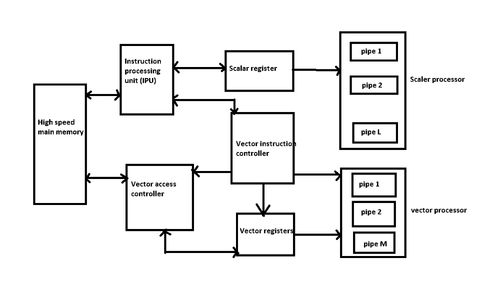
Vector Architecture (वेक्टर आर्किटेक्चर)
Vector Architecture Computer Architecture का वह design या structure होता है, जिसमें vector processing को efficiently perform करने के लिए विशेष hardware components और instructions का उपयोग किया जाता है।
Traditional processors जहाँ scalar processing करते हैं (एक समय में एक data value), वहीं Vector Architecture वाले processors multiple data elements पर parallel operation कर सकते हैं। इससे large mathematical calculations बहुत तेजी से complete हो जाती हैं।
यह architecture मुख्य रूप से scientific computing, supercomputers, artificial intelligence, image processing और weather forecasting systems में उपयोग किया जाता है।
Main Components of Vector Architecture
1. Vector Registers : Vector Registers बड़े registers होते हैं, जिनमें multiple data elements एक साथ store किए जा सकते हैं।
Example :
- V1 = (10, 20, 30, 40)
- V2 = (2, 4, 6, 8)
- इन registers में stored values पर processor एक साथ operation कर सकता है।
2. Vector Functional Units : Vector Functional Units वे hardware units होती हैं, जो vector operations perform करती हैं।
इन units के द्वारा निम्न operations किए जा सकते हैं :
- Vector Addition
- Vector Subtraction
- Vector Multiplication
- Vector Division
यह units parallel तरीके से data process करती हैं, जिससे execution speed बढ़ जाती है।
3. Vector Control Unit : Vector Control Unit vector instructions को control और manage करती है।
मुख्य कार्य :
- Vector instructions को decode करना
- Vector operations को control करना
- Data flow को manage करना
4. Memory System : Vector Architecture में high-speed memory system की आवश्यकता होती है क्योंकि vector operations में large data sets process होते हैं।
- Vector data जल्दी access किया जा सकता है
- Data transfer तेजी से होता है
Working Concept
- Data Storage : सबसे पहले data को vector (array) form में main memory में store किया जाता है।
- Instruction Fetch : CPU memory से vector instruction को fetch करता है।
- Instruction Decode : Control Unit instruction को decode करती है और यह निर्धारित करती है कि कौन-सा vector operation perform करना है।
- Data Loading : आवश्यक data को vector registers में load किया जाता है।
- Parallel Execution : Vector Functional Units एक ही instruction के द्वारा multiple data elements पर simultaneously operation perform करती हैं।
- Pipeline Processing : कई vector operations pipeline technique की मदद से लगातार execute होते रहते हैं, जिससे speed बढ़ जाती है।
- Result Storage : Operation पूरा होने के बाद result वापस vector registers से main memory में store कर दिया जाता है।
- High-Speed Processing : इस पूरे process के कारण large data calculations बहुत तेजी से complete हो जाती हैं।
Types of Vector Processing
(Vector Processing के प्रकार)
Computer Architecture में Vector Processing को सामान्यतः दो मुख्य प्रकारों में divide किया जाता है। इन types का अंतर मुख्य रूप से इस बात पर निर्भर करता है कि vector data कहाँ store होता है और operations कहाँ perform होते हैं।
मुख्यतः Vector Processing के दो प्रकार होते हैं :
- Memory–Memory Vector Processing
- Register–Register Vector Processing
1. Memory–Memory Vector Processing
Memory–Memory Vector Processing में vector data सीधे main memory में store होता है, और processor operations भी directly memory locations पर perform करता है।
इस architecture में processor को vector registers की ज्यादा आवश्यकता नहीं होती, क्योंकि data सीधे memory से read और write किया जाता है।
Example
मान लीजिए दो vectors memory में stored हैं:
- A = (5, 10, 15, 20)
- B = (1, 2, 3, 4)
- Vector instruction: C = A + B
Processor memory से values पढ़कर addition perform करता है और result फिर memory में store कर देता है।
2. Register–Register Vector Processing
Register–Register Vector Processing में vector data पहले vector registers में load किया जाता है, और operations registers के अंदर perform किए जाते हैं।
इस method में processor पहले memory से data लेकर registers में store करता है, फिर vector operations perform करता है, और अंत में result वापस memory में store करता है।
Working Steps
- Memory से vector data vector registers में load होता है।
- Vector Functional Units registers पर operation perform करती हैं।
- Result वापस memory में store कर दिया जाता है।
Example
V1 = (2, 4, 6, 8)
V2 = (1, 3, 5, 7)
V3 = V1 + V2
Result : V3 = (3, 7, 11, 15)
Vector Instructions (वेक्टर इंस्ट्रक्शन्स)
Vector Instructions वे विशेष instructions होती हैं, जिनका उपयोग vector processor द्वारा multiple data elements पर एक साथ operation perform करने के लिए किया जाता है।
Scalar processing में जहाँ processor एक समय में एक data value पर operation करता है, वहीं Vector Instructions की मदद से एक ही instruction कई data values (vector elements) पर apply हो सकती है।
मुख्य प्रकार
1. Vector Load Instruction : Vector Load Instruction का उपयोग main memory से vector data को vector registers में load करने के लिए किया जाता है।
- Example : LOAD V1
- इस instruction से memory में stored data vector register V1 में load हो जाता है।
2. Vector Store Instruction : Vector Store Instruction का उपयोग vector register में stored data को वापस memory में store करने के लिए किया जाता है।
- Example : STORE V1
- इस instruction से vector register V1 का data memory में store हो जाता है।
3. Vector Addition Instruction : इस instruction का उपयोग दो vectors को add करने के लिए किया जाता है।
- Example : V3 = V1 + V2
- यदि:
- V1 = (2,4,6,8)
- V2 = (1,3,5,7)
- result : V3 = (3,7,11,15)
4. Vector Subtraction Instruction : इस instruction से दो vectors के elements को subtract किया जाता है।
- Example : V3 = V1 – V2
5. Vector Multiplication Instruction : इस instruction का उपयोग दो vectors के elements को multiply करने के लिए किया जाता है।
- Example : V3 = V1 × V2
6. Vector Division Instruction : इस instruction के द्वारा vector elements को divide किया जाता है।
- Example : V3 = V1 ÷ V2
Advantages of Vector Processing (लाभ)
- High Speed Processing : Vector Processing में एक ही instruction से multiple data elements पर operation किया जाता है, जिससे calculations बहुत तेजी से पूरी होती हैं।
- Better Performance : Large data sets को efficiently process करने के कारण system की overall performance improve हो जाती है।
- Efficient for Scientific Calculations : Scientific applications जैसे weather forecasting, space research और simulations में large mathematical calculations होती हैं, जिनके लिए vector processing बहुत useful है।
- Reduced Instruction Overhead : Scalar processing में हर data element के लिए अलग instruction execute करनी पड़ती है, जबकि vector processing में एक instruction से कई operations हो जाते हैं।
- Parallel Processing Support : Vector processors एक साथ कई operations perform कर सकते हैं, जिससे parallel processing capability बढ़ती है।
- Better CPU Utilization : Processor के resources का बेहतर उपयोग होता है, और CPU idle time कम हो जाता है।
Disadvantages of Vector Processing (हानियाँ)
- Expensive Hardware : Vector processors का hardware design complex होता है, इसलिए इनकी cost अधिक होती है।
- Not Suitable for All Applications : हर application vector operations के लिए suitable नहीं होती, खासकर जहाँ data operations अलग-अलग प्रकार के हों।
- Programming Complexity : Vector programs लिखना और optimize करना थोड़ा difficult हो सकता है।
- High Memory Bandwidth Requirement : Vector processing में large amount of data transfer होता है, इसलिए high-speed memory system की आवश्यकता होती है।
- Limited Flexibility : यह technique मुख्य रूप से same type of operations के लिए efficient होती है, complex logic वाले tasks के लिए नहीं।
Vector Processing Real-Life Applications
- Weather Forecasting: Temperature, pressure, wind, humidity analysis
- Space Research: Satellite image processing, simulations, orbit calculations
- Image Processing / Graphics: Photo editing, video processing, 3D rendering
- AI & ML: Face recognition, speech recognition, recommendation systems
- Scientific Research: Climate modeling, molecular simulations, physics experiments
Vector Processing vs Parallel Processing
Basis | Vector Processing | Parallel Processing |
Definition | इसमें एक ही instruction को multiple data elements पर एक साथ apply किया जाता है। | इसमें कई processors या cores मिलकर अलग-अलग tasks को एक साथ execute करते हैं। |
Processing Principle | यह SIMD (Single Instruction Multiple Data) principle पर आधारित होती है। | यह सामान्यतः MIMD (Multiple Instruction Multiple Data) principle पर आधारित होती है। |
Instruction Execution | एक instruction कई data values पर perform होती है। | अलग-अलग instructions अलग-अलग processors द्वारा execute होती हैं। |
Hardware Requirement | इसमें Vector Processor और Vector Registers की आवश्यकता होती है। | इसमें Multiple CPUs, Cores या Processors की आवश्यकता होती है। |
Type of Operation | Same type की operation large data sets पर perform होती है। | Different operations और tasks एक साथ perform हो सकते हैं। |
Performance Focus | Large mathematical calculations को fast करना इसका मुख्य उद्देश्य होता है। | Multiple programs या tasks को simultaneously execute करना इसका उद्देश्य होता है। |
Applications | Scientific computing, image processing, weather forecasting, supercomputers आदि। | Multitasking systems, distributed systems, cloud computing, big data processing आदि। |
Example | 1000 numbers को add करने के लिए एक instruction का उपयोग। | अलग-अलग processors एक साथ अलग-अलग programs run करते हैं। |
Future of Vector Processing
आज के modern processors में vector processing का महत्व लगातार बढ़ रहा है।
कुछ technologies जिनमें इसका उपयोग हो रहा है :
- Artificial Intelligence
- Machine Learning
- GPU Computing
- Big Data Analytics
- Scientific Simulations
Conclusion (निष्कर्ष)
- Vector Processing Computer Architecture की एक advanced technique है, जिसमें single instruction के द्वारा multiple data elements पर एक साथ operation किया जाता है।
- यह technique मुख्य रूप से SIMD (Single Instruction Multiple Data) principle पर आधारित होती है।
- Vector Processing का उपयोग large mathematical calculations और scientific computations को fast करने के लिए किया जाता है।
- इसमें vector registers, vector functional units और high-speed memory system महत्वपूर्ण भूमिका निभाते हैं।
- Vector Processing विशेष रूप से weather forecasting, image processing, artificial intelligence और supercomputers में उपयोगी होती है।
- यह technique system performance और processing speed दोनों को improve करती है।
- Future में AI, big data analytics और high-performance computing के कारण Vector Processing का महत्व और भी बढ़ने वाला है।
FAQ (अक्सर पूछे जाने वाले प्रश्न)
- Vector Processing क्या है?
- Vector Processing एक processing technique है, जिसमें एक ही instruction के द्वारा multiple data elements पर एक साथ operation किया जाता है।
- Vector Processing एक processing technique है, जिसमें एक ही instruction के द्वारा multiple data elements पर एक साथ operation किया जाता है।
- Vector Processor क्या होता है?
- Vector Processor एक special type का processor होता है, जो vector instructions का उपयोग करके large data sets पर fast calculations perform करता है।
- Vector Processor एक special type का processor होता है, जो vector instructions का उपयोग करके large data sets पर fast calculations perform करता है।
- Vector Processing किस principle पर आधारित होती है?
- Vector Processing मुख्य रूप से SIMD (Single Instruction Multiple Data) principle पर आधारित होती है।
- Vector Processing मुख्य रूप से SIMD (Single Instruction Multiple Data) principle पर आधारित होती है।
- Vector Processing के मुख्य components कौन-से हैं?
- इसके मुख्य components हैं :
- Vector Registers
- Vector Functional Units
- Control Unit
- High-Speed Memory System
- इसके मुख्य components हैं :
- Vector Processing का उपयोग कहाँ किया जाता है?
- Vector Processing का उपयोग कई क्षेत्रों में किया जाता है, जैसे :
- Weather Forecasting
- Artificial Intelligence
- Image Processing
- Scientific Research
- Supercomputers
- Vector Processing का उपयोग कई क्षेत्रों में किया जाता है, जैसे :
- Vector Processing और Scalar Processing में क्या अंतर है?
- Scalar Processing में processor एक समय में एक data value पर operation करता है, जबकि Vector Processing में multiple data values पर एक साथ operation किया जाता है।
- Scalar Processing में processor एक समय में एक data value पर operation करता है, जबकि Vector Processing में multiple data values पर एक साथ operation किया जाता है।
- Vector Processing का सबसे बड़ा advantage क्या है?
- इसका सबसे बड़ा advantage high-speed processing और large data calculations को तेजी से perform करना है।