

Multistage Graph
Multistage Graph वह Directed Graph है, जिसमें vertices (nodes) अलग-अलग stages में divided होते हैं। हर node केवल अगली stage के nodes से connected होता है, edges हमेशा एक directional और ordered flow में होते हैं।
Table of Contents
ToggleKey Points :
- Directed Graph – Edges हमेशा एक direction में होते हैं।
- Stage-wise Nodes – Vertices अलग-अलग stages में divided होते हैं।
- Ordered Flow – Stage 1 से Stage N तक path हमेशा आगे बढ़ता है।
- No Loops – किसी node से previous stage में वापस नहीं जा सकते।
- Used in Shortest Path Problems – Cheapest या optimal path निकालने में helpful है।
- Dynamic Programming Friendly – Stage order होने के कारण DP algorithms आसानी से use किए जा सकते हैं।
- Applications – IRCTC route planning, Flipkart delivery, Flight booking, Project scheduling आदि।
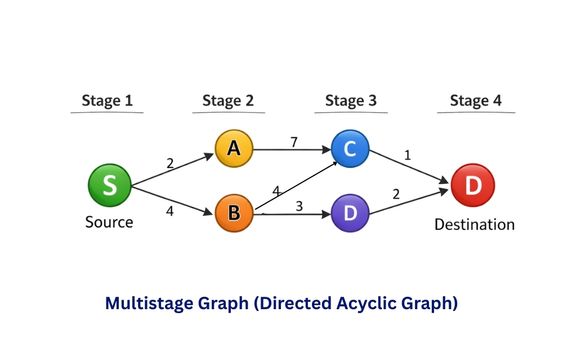
Key Features (प्रमुख विशेषताऐं)
- Directed Graph: Edges केवल एक direction में होते हैं। हर node केवल अगले stage के node से connect होता है।
- Stage-wise Structure: Nodes अलग-अलग stages/levels में arranged होते हैं।
- Forward Edges Only: Graph में loops या backward edges नहीं होते।
- Source and Destination : Graph एक source node (S) से start और एक destination node (D) पर end होता है।
- Optimal Path Problem: Dynamic Programming approach से efficiently solve किया जा सकता है।
Key Terms (मुख्य शब्द)
| Term | Meaning |
|---|---|
| Stage | Nodes का level, जैसे Stage 1, Stage 2,… Stage k |
| Node | Graph का एक vertex |
| Edge | Nodes को connect करने वाला path, weight के साथ |
| Weight | Edge का cost या distance |
| Path | Source से Destination तक का route |
| Cost/Distance | Path में सभी edges का total sum |
Algorithm Design (Dynamic Programming Approach)
Multistage Graph problem को Dynamic Programming से efficiently solve किया जाता है।
Step-by-Step Algorithm (Bottom-Up DP)
1. Stage Initialization:
- Start from last stage (Destination D) और backward calculate करें।
- Cost[D] = 0
2. Compute Cost for Other Nodes:
- हर node i के लिए, next stage के सभी nodes j देखें।
- Formula:
- cost[i]=min(c(i,j) + cost[j]
- जहाँ c(i,j) = edge weight from i to j
3. Repeat Stage by Stage:
Step 2 को हर previous stage के लिए repeat करें।
4. Optimal Path:
Source node S से start करके, next node हमेशा minimum cost वाला next stage node choose करें।
Pseudo Code
Input: Multistage Graph G(V,E), edge weights c(i,j)
Output: Minimum cost path from Source S to Destination D
1. Let n = number of nodes
2. cost[D] = 0 // Last node
3. for i = n-1 to 1 do
4. cost[i] = ∞
5. for each node j such that edge(i,j) exists do
6. if cost[i] > c(i,j) + cost[j] then
7. cost[i] = c(i,j) + cost[j]
8. next[i] = j
9. end for
10. Print “Minimum Cost =”, cost[S]
11. path = S
12. while path last node != D do
13. path.append(next[path.last])
14. Print path
Example (उदाहरण)
Step 1: Start from the Destination Node.
- Destination node का cost हमेशा 0 होता है।
- Cost[D] = 0
Step 2: Calculate the cost of the nodes in Stage 3
- Node C
- Cost[C] = Cost(C→D) + Cost[D]
- = 1 + 0 = 1
- Node D (Stage 3)
- Cost[D₃] = Cost(D→D) + Cost[D]
- = 2 + 0 = 2
Step 3: Calculate the cost of the nodes in Stage 2.
- Node A
- Cost[A] = Cost(A→C) + Cost[C]
- = 7 + 1 = 8
- Node B
- Cost[B] = min( B→C + Cost[C] , B→D + Cost[D₃] )
- = min( 4 + 1 , 3 + 2 )
- = min(5 , 5) = 5
Step 4: Calculate the cost of the Source Node (S).
- Cost[S] = min( S→A + Cost[A] , S→B + Cost[B] )
- = min( 2 + 8 , 4 + 5 )
- = min(10 , 9) = 9
Step 5: Minimum Cost Path निकालें
Possible Paths:
- S → A → C → D = 10
- S → B → C → D = 9
- S → B → D → D = 9
Minimum Cost = 9
One Optimal Path:
- S → B → C → D
- S → B → D → D
Applications of Multistage Graph (अनुप्रयोग)
- Network Routing: Computer networks में source से destination तक minimum cost / shortest path निकालने के लिए Multistage Graph का उपयोग किया जाता है।
- Project Scheduling: बड़े projects को कई stages में divide करके minimum time या minimum cost में complete करने के लिए Multistage Graph helpful होता है।
- Transportation Problem: Cities या locations के बीच least cost route खोजने के लिए Multistage Graph का प्रयोग किया जाता है।
- Multi-stage Decision Making: जहाँ decision step-by-step लेना होता है (जैसे business planning), वहाँ Multistage Graph best solution देता है।
- Production & Manufacturing Planning: Manufacturing process को अलग-अलग stages में plan करके overall cost minimize करने में Multistage Graph का उपयोग होता है।
- Dynamic Programming Problems: Multistage Graph, Dynamic Programming का practical application है और DP concepts को समझने में मदद करता है।
Advantages of Multistage Graph (लाभ)
- Optimal Solution: Multistage Graph हमेशा minimum cost / shortest path निकालने में मदद करता है।
- Dynamic Programming Friendly: Dynamic Programming approach से problem को efficiently solve किया जा सकता है।
- Clear Structure: Graph stages में divided होता है, जिससे problem को समझना आसान हो जाता है।
- No Cycles (DAG): Directed Acyclic Graph होने के कारण infinite loop की problem नहीं होती।
- Useful for Real-life Problems: Network routing, project planning और transportation जैसी problems में बहुत useful है।
Disadvantages of Multistage Graph (सीमाएँ)
- Limited Graph Structure: Only stage-wise (layered) graphs पर ही applicable होता है।
- Backward Calculation Required: Solution destination से backward calculate करना पड़ता है, जो beginners के लिए confusing हो सकता है।
- High Memory Usage: Large graph के लिए cost array या DP table रखने में ज्यादा memory लगती है।
- Not Suitable for All Problems: Cyclic graphs या general graphs के लिए Multistage Graph approach use नहीं की जा सकती।
- Complex Implementation: Cost calculation और optimal path tracking beginners के लिए difficult होता है।