
Divide And Conquer Technique (परिभाषा)
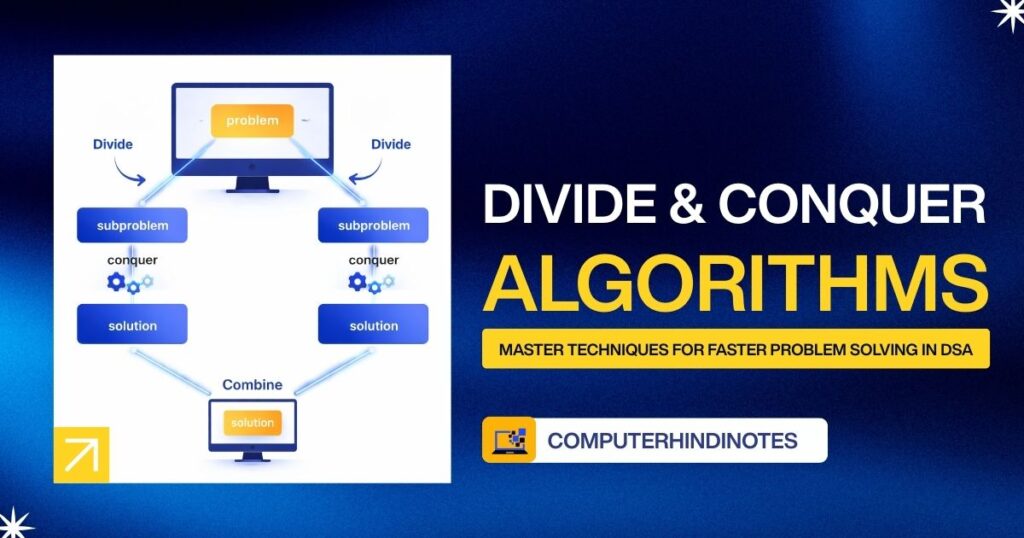
Divide and Conquer Technique एक algorithm design technique है, जिसमें किसी complex problem को छोटे, manageable sub-problems में divide किया जाता है। फिर हर sub-problem को recursively solve किया जाता है और Last में उनके solutions को combine करके original problem का final solution प्राप्त किया जाता है।
Table of Contents
ToggleKey Points :
- यह recursion पर आधारित होती है।
- Problem हमेशा independent sub-problems में split होती है।
- Merge और Quick Sort, Binary Search, Strassen Matrix Multiplication इसके common examples हैं।
How Divide and Conquer Works (कैसे काम करती है?)
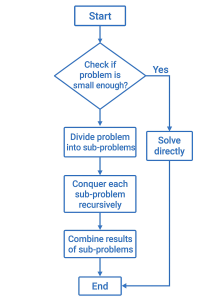
Divide and Conquer technique किसी भी complex problem को solve करने के लिए तीन main steps follow करती है :
1. Divide (बाँटना)
- सबसे पहले बड़ी problem को छोटे, manageable sub-problems में split किया जाता है।
- ये sub-problems मूल problem के जैसे ही होते हैं, लेकिन छोटे होते हैं।
Example :
- Merge Sort : Array को दो halves में divide किया जाता है।
- Binary Search : Sorted array को mid-point पर divide किया जाता है।
2. Conquer (हल करना)
- अब हर छोटे sub-problem को recursively solve किया जाता है।
- Recursive approach की मदद से small sub-problems धीरे-धीरे हल हो जाते हैं।
- Base condition (smallest problem) तक पहुँचने पर direct solution दिया जाता है।
Example :
- Merge Sort में sub-arrays को sort करने के बाद दोनों sorted halves को merge किया जाता है, जिससे पूरा array sorted output के रूप में मिलता है।
3. Combine (जोड़ना)
- Sub-problems का solution मिलाकर original problem का final solution तैयार किया जाता है।
- Merge या combine step बहुत महत्वपूर्ण है क्योंकि यही final answer देती है।
Example :
- Merge Sort: Sorted halves को merge करके पूरी array sorted बन जाती है।
Flow of Divide and Conquer
Why Use Divide and Conquer? (क्यों उपयोग करें?)
Divide and Conquer technique इसलिए popular है, क्योंकि यह complex problems को efficiently और systematically solve करने में मदद करती है।
1. Makes Large Problems Manageable
- बड़ी problem को छोटे-छोटे sub-problems में divide करने से हर भाग को individually समझना और efficiently solve करना आसान हो जाता है।
2. Recursion-based Efficient Solution
- Divide and Conquer algorithms recursion पर आधारित होते हैं।
- Sub-problems का solution reuse किया जा सकता है, जिससे time efficiency बढ़ती है।
3. Enables Parallelism
- Independent sub-problems को अलग-अलग processor/core पर simultaneously solve किया जा सकता है।
- इससे modern computer systems, multi-core processors और cloud computing environments में overall performance और speed में noticeable boost मिलता है।
4. Reduces Time Complexity
- जब बड़ी problem को छोटे sub-problems में divide किया जाता है, तो उसकी overall time complexity इन छोटे-छोटे हिस्सों में distribute हो जाती है, जिससे computation अधिक manageable और efficient हो जाता है।
Designing a D&C Algorithm (Design कैसे करें?)
- Identify the Problem : पहले clearly define करें कि problem क्या है |
- Define the Base Case : वह सबसे छोटा point क्या है जहाँ problem को सीधे solve किया जा सकता है?।
- The Divide Strategy : problem को छोटे, समान subproblems में कैसे बाँटें?।
- The Conquer Step (Recursive Call) : लिखे गए subproblems को solve करने के लिए same function को call करें।
- The Combine Strategy : Subproblems के solutions को Efficiently और Correctly कैसे merge करें? यह part Time Complexity को define करता है।
Advantages of Divide and Conquer (लाभ)
- Complex problems को छोटे manageable parts में divide करने से उन्हें समझना और solve करना आसान हो जाता है।
- Recursive approach algorithm को logically simple, clean और well-structured बनाती है।
- Independent sub-problems होने पर parallel processing आसानी से possible होती है, जिससे speed बढ़ती है।
- कई complex problems की time complexity काफी improve होती है, जैसे O(n²) से O(n log n) (Merge Sort, Quick Sort average case)।
- Sub-proproblem solutions reusable होते हैं, जिससे redundant computation कम होता है।
- Memory utilization organized रहती है, क्योंकि recursion stack structured और well-defined होता है।
- Real-world applications जैसे Searching, Sorting, Matrices operations, Image Processing, Data Processing आदि में यह technique highly effective है।
- Large datasets (जैसे Flipkart, IRCTC, Banking data) पर Divide and Conquer algorithms fast और scalable performance प्रदान करते हैं
Disadvantages of Divide and Conquer (हानियाँ)
- Recursion extra stack memory consume करती है, जिससे stack overflow का risk बढ़ जाता है।
- कुछ problems में divide या combine step बहुत heavy होता है, जिससे algorithm slow हो सकता है (e.g., Matrix Multiplication)।
- अगर sub-problems independent न हों, तो Divide and Conquer technique inefficient हो सकती है।
- Combine step inefficient होने पर overall performance गिर सकती है, जैसे Quick Sort का worst case O(n²)।
- छोटे input size के लिए iterative methods अधिक fast होती हैं, इसलिए D&C हर जगह best choice नहीं है।
- Recursive calls का debugging और tracing कई बार complex और time-consuming होता है।
Divide and Conquer vs Greedy vs Dynamic Programming
| Feature | Divide and Conquer (D&C) | Greedy | Dynamic Programming (DP) |
|---|---|---|---|
| Approach | बड़ी problem को छोटे independent sub-problems में divide करके recursively solve करना | हर step पर best local choice लेना | Problem को sub-problems में divide करके solutions store और reuse करना |
| Sub-problems | Independent | Independent | Overlapping (dependent) |
| Optimality | हमेशा नहीं, problem पर depend करता है | तभी सही जब greedy-choice property और optimal substructure हो | हमेशा optimal अगर problem में optimal substructure हो |
| Solution Reuse | Generally नहीं | नहीं | हाँ, sub-problem solutions reuse होते हैं |
| Recursion | हाँ, extensively | कम | हाँ, memoization के साथ |
| Time Complexity | Divide और combine पर depend करता है (e.g., Merge Sort O(n log n)) | Usually fast, linear या near-linear | Reduced using memoization/tabulation (e.g., Fibonacci O(n)) |
| Space Complexity | Recursion stack use होता है | Low, usually constant | Extra memory for DP table |
| Applications | Sorting, Binary Search, Matrix Multiplication | MST (Prim/Kruskal), Huffman Coding | Fibonacci, Knapsack, LCS, Matrix Chain Multiplication |