
Dynamic Programming
Dynamic Programming (DP) एक powerful algorithmic technique है, जिसका उपयोग उन problems को efficiently solve करने के लिए किया जाता है, जिनमें overlapping subproblems और optimal substructure होती है।
Table of Contents
Toggleइस technique में किसी बड़ी problem को छोटे–छोटे subproblems में divide किया जाता है और हर subproblem के result को memory (array या table) में store कर लिया जाता है, जिससे एक ही calculation को बार-बार repeat न करना पड़े।
Dynamic Programming का मुख्य goal time complexity को reduce करना और problem का optimal solution प्राप्त करना होता है।
यह technique विशेष रूप से optimization problems जैसे Fibonacci Series, Knapsack Problem, Longest Common Subsequence (LCS) और Shortest Path Algorithms में widely use की जाती है।
History of Dynamic Programming
(Dynamic Programming का इतिहास)
Dynamic Programming concept को Richard Bellman ने 1950 के दशक में introduce किया था। उस समय इसका main focus computer programming नहीं था, multi-stage decision making और optimization problems को efficiently solve करना था।
Bellman ने Principle of Optimality दिया, जिसके अनुसार किसी भी problem का optimal solution, उसके sub-problems के optimal solutions से मिलकर बनता है।
Dynamic Programming का उपयोग Operations Research, Military Planning, Resource Allocation और Control Systems जैसे क्षेत्रों में किया गया। बाद में computers के development के साथ-साथ यह technique Computer Science और Algorithm Design का एक important part बन गई।
Dynamic Programming का use Shortest Path, Knapsack Problem, Job Scheduling, Artificial Intelligence (AI) और Machine Learning जैसी advanced applications में किया जाता है।
Why Dynamic Programming is Needed?
(Dynamic Programming की आवश्यकता क्यों है?)
1. Issue of Repeated Subproblems
- computational problems में एक ही subproblem बार-बार solve करना पड़ता है।
- Dynamic Programming इन values को memory में store कर लेती है, जिससे repeated calculation avoid हो जाती है।
2. Excessive Time Complexity
- Brute force और simple recursion approaches की time complexity exponential (2ⁿ) होती है।
- Dynamic Programming इस complexity को polynomial level (O(n), O(n²)) तक reduce कर देती है। इसी कारण large input size वाले problems, DP के बिना practically solve करना impossible हो जाता है।
3. Efficient Handling of Large Input Sizes
- Modern applications में data size काफी बड़ा होता है। Dynamic Programming बड़े datasets के साथ भी efficient, fast और reliable performance देती है।
4. To Obtain the Best (Optimal) Solution
- problems में केवल solution नहीं, बल्कि best या optimal solution की आवश्यकता होती है। DP Principle of Optimality पर based होती है, जिससे final result best होता है।
5. Proper Use of Memory–Time Trade-off
- Dynamic Programming extra memory use करती है, लेकिन execution time काफी कम कर देती है। यह memory–time trade-off real-world systems में बहुत useful होता है।
6. To Solve Complex Decision-Making Problems
- DP उन problems के लिए best है, जिनमें step-by-step (multi-stage) decisions लेने पड़ते हैं।
- Examples :
- Shortest Path Selection
- Resource Allocation
- Job Scheduling
7. Demand from Real-World Applications
- Dynamic Programming का use कई real-life systems में किया जाता है, जैसे :
- IRCTC – Seat allocation और waiting list management
- Google Maps – Shortest route calculation
- ISRO – Fuel optimization और mission planning
- E-Commerce Platforms – Cost और profit optimization
8. To Overcome the Limitations of Recursion
- Deep recursion से stack overflow जैसी problems हो सकती हैं।
- Dynamic Programming की iterative (tabulation) approach इन limitations को effectively overcome करती है।
Types of Dynamic Programming (प्रकार)
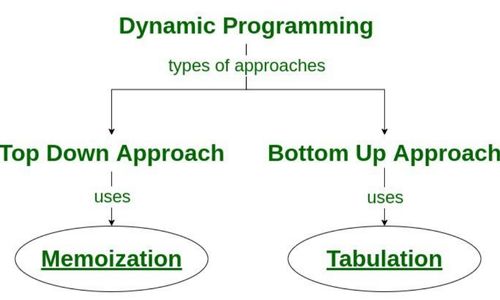
Dynamic Programming के दो main approaches हैं :
- Top-Down Approach (Memoization)
- Bottom-Up Approach (Tabulation)
1. Top-Down Approach (Memoization)
Top-Down approach में problem को recursion की help से solve किया जाता है। जब कोई subproblem पहली बार solve होता है, तो उसका result memory (array या map) में store कर लिया जाता है। इसके बाद जब वही subproblem फिर से occur होता है, तो program सीधे stored result को use कर लेता है, जिससे repeated calculation avoid हो जाती है।
इस technique को Memoization कहा जाता है।
Example :
- Fibonacci Series
- 0/1 Knapsack (Recursive + Memoization)
Fibonacci using Memoization
def fib(n, memo={}):
if n in memo:
return memo[n]
if n <= 1:
return n
memo[n] = fib(n-1, memo) + fib(n-2, memo)
return memo[n]
Advantages of Top-Down Approach
- Easy to Understand : Recursion based होने के कारण logic समझना आसान होता है।
- Natural Problem Solving Style : Problem को original form में solve किया जाता है, इसलिए flow clear रहता है।
- Avoids Repeated Calculations : Same subproblem का result memory में store हो जाता है और reuse होता है।
- Useful for Complex Problems : Large और complicated problems में coding आसान हो जाती है।
- Efficient than Simple Recursion : Normal recursion की तुलना में time complexity कम हो जाती है।
Disadvantages of Top-Down Approach
- Recursion Overhead : Function calls की वजह से extra overhead होता है।
- Stack Overflow Risk : Deep recursion में stack overflow की problem आ सकती है।
- Extra Memory Usage : DP table + recursion stack दोनों memory consume करते हैं।
- Execution Slower than Tabulation : Bottom-Up approach की तुलना में slow होता है।
- Not Suitable for Very Large Input : Large input size पर recursion limit issue बन सकता है।
2. Bottom-Up Approach (Tabulation)
Bottom-Up Approach, Dynamic Programming का वह method है, जिसमें problem को सबसे छोटे subproblem से start करके step-by-step बड़े problem तक solve किया जाता है। इसमें recursion का use नहीं किया जाता, एक table (array) को sequential order में fill किया जाता है। इस technique को Tabulation कहा जाता है।
Example :
- Fibonacci (Iterative DP)
- Matrix Chain Multiplication
- Floyd–Warshall Algorithm
Fibonacci using Tabulation
def fib(n):
dp = [0]*(n+1)
dp[1] = 1
for i in range(2, n+1):
dp[i] = dp[i-1] + dp[i-2]
return dp[n]
Advantages of Bottom-Up Approach
- No Recursion Used : Iterative method होने की वजह से recursion का use नहीं होता।
- No Stack Overflow Problem : Call stack use न होने के कारण stack overflow का risk नहीं रहता।
- Fast Execution : Values sequentially calculate होती हैं, इसलिए execution speed ज्यादा होती है।
- Better Time Efficiency : subproblem को एक बार solve किया जाता है।
- Predictable Performance : Time complexity पहले से clear रहती है, जिससे performance stable रहती है।
- Suitable for Large Inputs : Large data size वाले problems के लिए ज्यादा reliable approach है।
Disadvantages of Bottom-Up Approach
- Extra Memory Requirement : Complete DP table store करनी पड़ती है, जिससे memory usage बढ़ जाती है।
- All Subproblems Solve : कुछ subproblems final answer में use न हों, फिर भी compute करने पड़ते हैं।
- Implementation Complex : Table design और indexing beginners के लिए confusing हो सकती है।
- Less Intuitive for Some Problems : Recursive logic की तुलना में इसका flow समझना थोड़ा challenging हो सकता है।
- The table size has to be decided in advance : Wrong size लेने पर error या wastage हो सकता है।
Applications of Dynamic Programming (अनुप्रयोग)
- Cashback Optimization : Paytm, PhonePe जैसे apps में users को maximum cashback और discounts offer करने के लिए DP algorithms use होती हैं।
- Portfolio Optimization : Investment decisions लेते समय maximum return और minimum risk balance करने के लिए DP का use होता है।
- Loan Repayment Planning : EMI और loan optimization problems में DP schedule बनाता है।
- Shortest Path Problems : Graph-based problems like Dijkstra, DP techniques combine होते हैं।
- Text Auto-correction & Auto-complete : Google Search, Grammarly, AI text editors में LCS और edit distance algorithms DP पर based होते हैं।
- AI Decision Making : Reinforcement Learning में state-value functions DP techniques से compute होती हैं।
Advantages (लाभ)
- Time Efficient : Repeated subproblems को सिर्फ एक बार solve करके memory में store किया जाता है।
- Optimal Solution Guarantee : Problems में Optimal Substructure होने पर DP हमेशा best solution देती है।
- Overlapping Subproblems Handling : Recursive problems में same subproblems को बार-बार solve करने की आवश्यकता नहीं होती |
- Versatile Applications : Finance, E-commerce, AI, Robotics, Healthcare, Bioinformatics, Education आदि में उपयोगी है ।
- Memory Table Use (Memory efficient storage) : Computation के results को table में store करके reuse किया जा सकता है।
- Helps in Complex Problems : Knapsack, LCS, Matrix Chain Multiplication, Coin Change जैसी complicated problems को solve करना आसान है।
- Supports Both Approaches : Top-Down (Memoization) और Bottom-Up (Tabulation) दोनों method use की जा सकती है।
Disadvantages (सीमाएँ)
- High Memory Usage : Large tables या arrays रखने की वजह से memory का heavy usage होता है।
- Complex Implementation : Recurrence relation और table design beginners के लिए challenging हो सकता है।
- Not Always Intuitive : Problem का pattern समझना और recurrence निकालना beginners के लिए tricky होता है।
- Limited Applicability : केवल उन problems में उपयोगी होती है जिनमें overlapping subproblems और optimal substructure हों।
- Space-Time Tradeoff : Time तो बचता है लेकिन large DP table रखने के कारण space बढ़ सकता है।
- Debugging Difficulty : Recursive और memoized solutions में debugging और tracing करना difficult हो सकता है।