
Sorting (Sorting क्या है?)
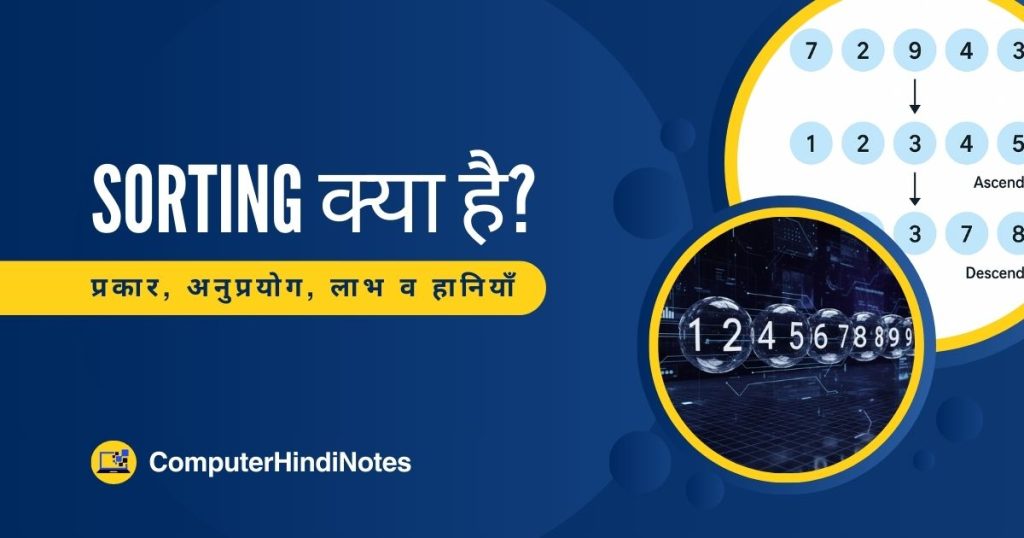
“Sorting एक ऐसी technique है, जिसमें डेटा को छोटे से बड़े (Ascending) या बड़े से छोटे (Descending) order में व्यवस्थित किया जाता है, ताकि searching, processing और data management आसान हो सके।”
common orders :
- Ascending Order → (1, 3, 7, 9, 12)
- Descending Order → (12, 9, 7, 3, 1)
- Lexicographical order → (A, B, C, …)
- Based on keys → (price, age, salary, marks)
Sorting Algorithms दो categories में divide किए जाते हैं :
1. Internal Sorting
- जब sorting main memory (RAM) में की जाती है → इसे Internal Sorting कहते हैं।
- Examples : Bubble, Selection, Insertion, Quick, Merge, Heap आदि।
2. External Sorting
- जब data इतना बड़ा हो कि RAM में fit न हो → sorting Hard Disk या SSD पर होती है।
- Example : External Merge Sort, K-way Merge
Importance of Sorting in Data Structure
(Sorting क्यों ज़रूरी है?)
Sorting Data Structure का एक बहुत ही महत्वपूर्ण concept है, क्योंकि यह पूरे data को एक logical order में arrange करता है। जब data properly sorted होता है, तो उसे तेज़, accurate, और efficient तरीके से process किया जा सकता है।
मुख्य महत्व (Importance)
1. Fast Searching is Possible
जब data sorted होता है, तब उस पर Binary Search जैसे fast searching algorithms use किए जा सकते हैं।
- Searching speed O(log n) तक improve हो जाती है।
- Required item को ढूँढने में कम समय लगता है।
2. Data Organization Improves
Sorting से data साफ और structured दिखता है।
- Duplicate values को पहचानना आसान हो जाता है।
- Data में मौजूद errors या गलत entries जल्दी दिखाई देती हैं।
3. Generating Reports is Easier
Schools, Colleges, Banks, Offices—सभी जगह sorting का इस्तेमाल रिपोर्ट तैयार करने में किया जाता है।
- Analysis जल्दी होता है
- PDF या Excel reports आसानी से बनती हैं
4. Processing Time is Reduced
Sorted data को process करने में algorithms को कम मेहनत लगती है।
- Complex operations तेज़ी से execute होते हैं
- Time complexity कई जगह reduce हो जाती है
5. Memory Utilization Improves
कुछ algorithms sorted data पर काम करते समय कम memory space consume करते हैं।
- Temporary storage की जरूरत कम पड़ती है
- Large datasets पर efficiency बढ़ती है
6. Smooth Experience in Real-Life Applications
Sorting का उपयोग रोजमर्रा की digital services में होता है :
- Flipkart / Amazon → Price Low-to-High Sorting
- IRCTC → Trains को Departure Time के अनुसार sort
- Google Maps → Locations को Distance के आधार पर sort
- Sorting के बिना user experience slow और confusing हो जाता है।
7. Creates a Base for Comparison-Based Algorithms
Sorting कई advanced algorithms के लिए foundation का काम करती है, जैसे –
- Searching algorithms
- Merging techniques
- Graph algorithms
- Database indexing
Sorted data पर ये algorithms और भी अधिक efficient तरीके से काम करते हैं।
Types of Sorting Algorithms (प्रकार)
Sorting Algorithms को दो मुख्य categories में divide किया गया है :
1. Comparison-Based Sorting Algorithms
इन algorithms में elements को आपस में compare करके सही order में arrange किया जाता है।
(a) Bubble Sort
- Adjacent elements compare किए जाते हैं।
- Wrong order होने पर swap करते हैं।
- Very simple but slow
- Time Complexity : O(n²)
(b) Selection Sort
- हर pass में smallest element को खोजकर उसकी correct position पर रखते हैं।
- Comparisons ज़्यादा, swaps कम।
- Time Complexity : O(n²)
(c) Insertion Sort
- Array को sorted + unsorted parts में divide करता है।
- Unsorted element को सही जगह insert करता है।
- Small datasets में fast, best case O(n)।
- Time Complexity : Worst → O(n²)
(d) Merge Sort
- Divide and Conquer strategy पर काम करता है।
- Array को बार-बार half में divide → फिर merge करता है।
- Very stable and consistent performance.
- Time Complexity : O(n log n)
(e) Quick Sort
- एक pivot choose करता है।
- Array को pivot के आधार पर small और large parts में divide करता है।
- Practically सबसे तेज़ comparison-based sorting।
- Average : O(n log n)
- Worst : O(n²)
(f) Heap Sort
- Binary Heap (Max-Heap या Min-Heap) use करता है।
- In-place sorting algorithm है।
- Time Complexity : O(n log n)
2. Non-Comparison Based Sorting Algorithms
ये algorithms comparisons पर depend नहीं करते, Frequency, buckets, या digits पर आधारित होते हैं। इनका performance linear time O(n) के आसपास होता है।
(a) Counting Sort
- Elements की frequency count करता है।
- Useful for small integer range datasets.
- Time Complexity : O(n + k)
(b) Radix Sort
- Numbers को digit-wise sort करता है।
- (Units → Tens → Hundreds…).
- Counting Sort को subroutine के रूप में use करता है।
- Big integers के लिए बहुत efficient है।
- Time Complexity : O(nk)
(c) Bucket Sort
- Data को अलग-अलग buckets में divide करता है।
- हर bucket को individually sort किया जाता है।
- Uniform distribution या real numbers में best performance।
- Time Complexity : Average O(n), Worst O(n²)
Applications of Sorting (अनुप्रयोग)
1. Fast Searching
- Sorted data पर Binary Search लागू होता है।
- Searching time O(n) से O(log n) हो जाता है।
- Example : Phone contact list में जल्दी नाम ढूँढना।
2. Data Organization
- Sorted data clean, readable और maintainable होता है।
- Files, records, tables हमेशा sorted रखे जाते हैं।
3. Database Indexing & Query Optimization
- DBMS systems (MySQL, Oracle) indexes बनाने के लिए sorting का इस्तेमाल करते हैं।
- इससे large datasets पर queries lightning-fast हो जाती हैं।
4. Duplicate Detection
Sorted list में समान elements easily detect होते हैं क्योंकि duplicates साथ-साथ आ जाते हैं।
5. Ranking & Ordering Systems
- Sorting से marks, scores, speed, rank list आसानी से बनती है।
- Example : Exam topper list, Sports leaderboard
6. Job Scheduling (Operating System)
- CPU scheduling algorithms में sorting का उपयोग होता है।
- Example : SJF (Shortest Job First), Priority Scheduling
Advantages of Sorting (लाभ)
- Searching becomes faster : Sorted data पर तेजी से search operations perform होते हैं।
- Data becomes well-organized : Data साफ, व्यवस्थित और पढ़ने में आसान होता है।
- Duplicates detection easier : समान values एक-साथ आ जाने से duplicate entries आसानी से मिलती हैं।
- Efficient data processing : Sorting से merging, grouping और filtering जैसे operations तेज़ होते हैं।
- Easy ranking and ordering : Marks, price, rating जैसी lists आसानी से बनाई जा सकती हैं।
- Improves database performance : Indexing और query processing अधिक तेज़ हो जाती है।
- Better memory utilization : Sorted data पर कुछ operations कम memory में perform होते हैं।
- Useful in scheduling algorithms : OS में SJF और priority-based scheduling sorting पर depend करते हैं।
Disadvantages of Sorting (हानियाँ)
- Takes extra time : बड़े data को sort करने में काफी समय लग सकता है।
- Consumes extra memory : कुछ sorting algorithms (जैसे Merge Sort) को additional memory की जरूरत होती है।
- Not suitable for real-time data : लगातार बदलते (dynamic) data को बार-बार sort करना मुश्किल और slow होता है।
- High computational cost : Complex sorting algorithms का processing cost अधिक हो सकता है।
- Risk of data modification : Sorting के दौरान records की original order खो सकती है (stability issue)।
- Inefficient for small datasets : छोटे data sets में sorting का फायदा कम और overhead ज्यादा होता है।
- May require preprocessing : कुछ algorithms को input को specific format में लाना पड़ता है।