
Association (एसोसिएशन)
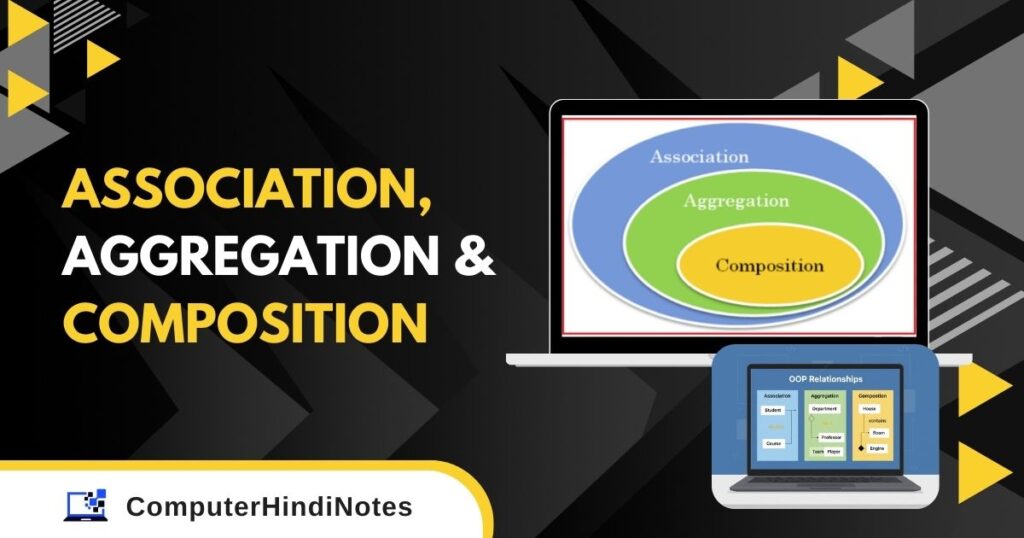
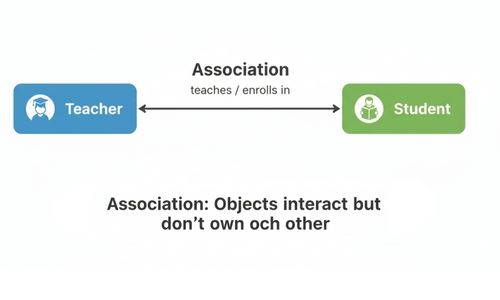
Association OOP में एक ऐसा relationship है, जिसमें दो objects सिर्फ आपस में interact करते हैं, लेकिन एक-दूसरे पर depend नहीं होते। दोनों independently exist कर सकते हैं।
Table of Contents
ToggleKey Points
- Association एक general relationship है।
- Objects एक-दूसरे से जुड़े होते हैं, लेकिन lifetime dependency नहीं होती।
- दोनों objects अलग-अलग भी exist कर सकते हैं।
- यह real world में communication या interaction को represent करता है।
- Association को UML में simple solid line से represent किया जाता है।
- ये Bidirectional या Unidirectional दोनों हो सकता है।
Syntax
class ClassA {
// data members
};
class ClassB {
ClassA obj; // Association
};
Example (उदाहरण)
Teacher और Student के बीच relation को Association माना जाता है, क्योंकि दोनों independently exist कर सकते हैं।
#include <iostream>
using namespace std;
class Student {
public:
string name;
Student(string n) {
name = n;
}
};
class Teacher {
public:
string name;
Teacher(string n) {
name = n;
}
// Association: Teacher uses Student
void teach(Student &s) {
cout << name << ” is teaching ” << s.name << endl;
}
};
int main() {
Student s1(“Rahul”);
Teacher t1(“Mr. Sharma”);
t1.teach(s1); // Association: Teacher ↔ Student
return 0;
}
Output: Mr. Sharma is teaching Rahul
Advantages of Association (लाभ)
- Loose Coupling : दो objects एक-दूसरे से loosely जुड़े रहते हैं, जिससे पूरा system flexible और maintain करना आसान होता है।
- Better Reusability : Classes independent होती हैं, इसलिए उन्हें multiple modules या applications में reuse किया जा सकता है।
- Easy to Understand & Implement : Association एक simple relation है; beginners के लिए भी समझना आसान है।
- Improved Modularity : हर class अपनी responsibility रखती है, जिससे code modular बनता है।
- Low Impact on Changes : अगर एक class में change किया जाए तो दूसरी classes पर बहुत कम असर पड़ता है
- Natural Real-World Mapping : Teacher–Student, Doctor–Patient जैसे real-world relations को represent करने के लिए best concept है |
Disadvantages of Association (हानियाँ)
- Weak Relationship : Objects loosely connected होते हैं, जिससे ownership या strong dependency represent नहीं हो पाती।
- Not Suitable for Complex Dependency Systems : जहाँ objects tightly connected हों (जैसे Part–Whole model), वहाँ Association fail हो जाता है; Composition की ज़रूरत पड़ती है।
- Overuse : अगर Multiple classes unnecessarily associated हों, तो system complex और hard-to-manage बन जाता है।
- No Lifetime Control : Association में यह control नहीं होता कि कौन-सा object कब create या destroy होगा, दोनों independently manage होते हैं।
- Lacks Ownership Concept : Association यह नहीं बताता कि object का owner कौन है, जिससे relationship clarity कम रहती है |
Aggregation (एग्रीगेशन)
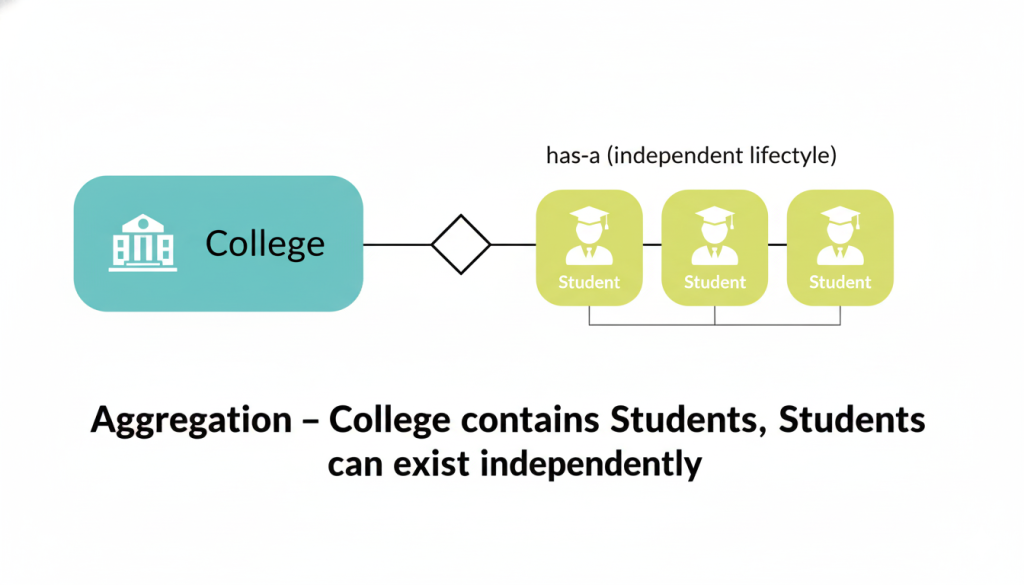
Aggregation OOP में एक special form of Association है, जहाँ एक object दूसरे object को contain करता है, लेकिन contained object independently exist कर सकता है।
Key Points
- यह Association का special case है।
- Container object के पास दूसरे object का reference होता है।
- दोनों objects का lifetime अलग–अलग होता है।
- Objects loosely connected होते हैं।
- UML diagram में empty diamond (◊) से show किया जाता है।
- Contained object अलग से create होता है और Multiple जगहों पर use हो सकता है।
Syntax
class ClassA { };
class ClassB {
private:
ClassA *obj; // Aggregation using pointer
public:
ClassB(ClassA *o) {
obj = o;
}
};
Example (उदाहरण)
College और Student – Student independently exist कर सकता है, लेकिन एक College अपने students की list contain करता है।
#include <iostream>
using namespace std;
class Student {
public:
string name;
Student(string n) {
name = n;
}
};
class College {
private:
Student *stu; // Aggregation (College HAS-A Student)
public:
College(Student *s) {
stu = s;
}
void showStudent() {
cout << “College has student: ” << stu->name << endl;
}
};
int main() {
Student s1(“Amit”); // Student independently exist
College c1(&s1); // Aggregation
c1.showStudent();
return 0;
}
Output: College has student: Amit
Advantages of Aggregation (लाभ)
- Code Reusability : Contained objects अलग-अलग parts में reuse हो सकते हैं।
- Loose Coupling: दोनों objects loosely connected होते हैं, flexibility बढ़ती है।
- Independent Lifetime : Contained object को अलग से create और destroy किया जा सकता है।
- Better Modular Design : हर class अपनी responsibility independently maintain करती है।
- Clear Relationship Representation : “Has-A” relationship को simple और effective represent करता है।
- Useful for Large Systems : जैसे ERP, Banking System, E-commerce apps — जहाँ कई independent components interact करते हैं।
Disadvantages of Aggregation (हानियाँ)
- Weak Ownership : Container class contained object की real ownership नहीं रखती।
- No Lifetime Control : Container destroy होने पर भी contained object delete नहीं होता, manually manage करना पड़ता है।
- Misuse Increases Complexity : बहुत ज्यादा aggregation relations system को complex बना सकते हैं।
- Not Suitable for Strong Dependency : जहाँ एक object दूसरे के बिना exist नहीं कर सकता, वहाँ aggregation useful नहीं होता हैं |
- Object Management Overhead: Independently existing objects की memory और lifecycle programmer को ही manage करनी पड़ती है।
Composition (कॉम्पोज़िशन)
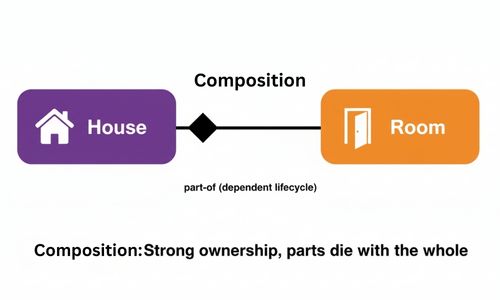
Composition Object-Oriented Programming में एक strong form of Association है, जिसमें एक class दूसरे class को पूर्ण रूप से own या contain करती है। इसमें contained object का life-cycle container object पर depend करता है। अगर parent object destroy हो जाता है, तो उसका contained child object भी destroy हो जाता है।
Key Points
- यह Strong (Has-a relationship) Association है।
- Child object का life-cycle parent पर depend करता है।
- Objects का tight coupling होता है।
- More secure and controlled design, क्योंकि child object बाहर से access/modify नहीं होता।
- Memory और structure पर complete control मिलता है।
- UML में filled diamond (◆) से represent किया जाता है।
Syntax
class Part {
// Child class
};
class Whole {
private:
Part obj; // Composition: Whole HAS-A Part (strong relationship)
public:
Whole() {
// obj automatically created
}
~Whole() {
// obj automatically destroyed WITH Whole
}
};
Example (उदाहरण)
class Engine {
public:
void start() {
cout << “Engine Started\n”;
}
};
class Car {
private:
Engine eng; // Composition
public:
void startCar() {
eng.start();
cout << “Car Running\n”;
}
};
int main() {
Car c;
c.startCar();
return 0;
}
Advantages of Composition (लाभ)
- Strong Ownership : Parent object contained objects का पूरा control रखता है।
- Strong Lifecycle M anagement : Parent destroy होने पर child automatically destroy हो जाता है |
- Better Data Protection : Objects tightly controlled होने के कारण misuse या unpredictable behavior कम होता है |
- High Cohesion : Class structure strong और meaningful बनती है।
- Encapsulation Stronger : Object का internal structure अच्छी तरह secure रहता है।
Disadvantages of Composition (हानियाँ)
- Tightly Coupled System : Objects एक-दूसरे पर बहुत depend होते हैं, flexibility कम हो जाती है।
- Less Reusability : Contained object दूसरे किसी class में reuse नहीं किया जा सकता क्योंकि उसका lifetime parent पर depend करता है।
- Complex Replacement : Parent class बदलने पर contained objects की structure redesign करनी पड़ती है।
- Testing Harder : Unit testing में independent objects create करना कठिन।
- Memory Overhead : Parent के destroy होते ही सभी child objects को भी destroy करना पड़ता है।
Difference Between Association, Aggregation, and Composition
| Feature (विशेषता) | Association (एसोसिएशन) | Aggregation (एग्रीगेशन) | Composition (कॉम्पोज़िशन) |
|---|---|---|---|
| Definition | Objects आपस में interact करते हैं, लेकिन ownership नहीं होती। | Whole-Part relationship, weak ownership, Part independent exist कर सकता है। | Strong Whole-Part relationship, Part dependent होता है, Whole के बिना Part exist नहीं कर सकता। |
| Ownership | कोई ownership नहीं | Weak ownership | Strong ownership |
| Part Lifespan | Part अलग से exist कर सकता है | Part independent रहता है, Whole के बिना भी exist कर सकता है | Part का जीवन Whole से जुड़ा होता है, Whole खत्म हुआ तो Part भी खत्म |
| UML Symbol | Simple line | Hollow diamond near Whole | Filled diamond near Whole |
| Example | Teacher ↔ Student (Teacher और Student interact करते हैं) | College → Students (Students बिना College के भी exist कर सकते हैं) | House → Rooms (Rooms बिना House के नहीं exist कर सकते) |
| Strength | Weak | Medium | Strong |
| Use | Simple interaction, loosely connected objects | Weak Whole-Part relationship दिखाने के लिए | Strong Whole-Part relationship दिखाने के लिए |