
Graph (ग्राफ़)
Graph एक mathematical structure है, जिसमें objects (vertices/nodes) और उनके बीच की connections (edges/lines) को represent किया जाता है।
Table of Contents
Toggle- Vertices (Nodes) : Graph में points या objects।
- Edges (Lines) : Vertices के बीच connections या relationships।
Formally, G = ( V, E )
जहाँ,
- V = set of vertices (nodes)
- E = set of edges (connections between vertices)
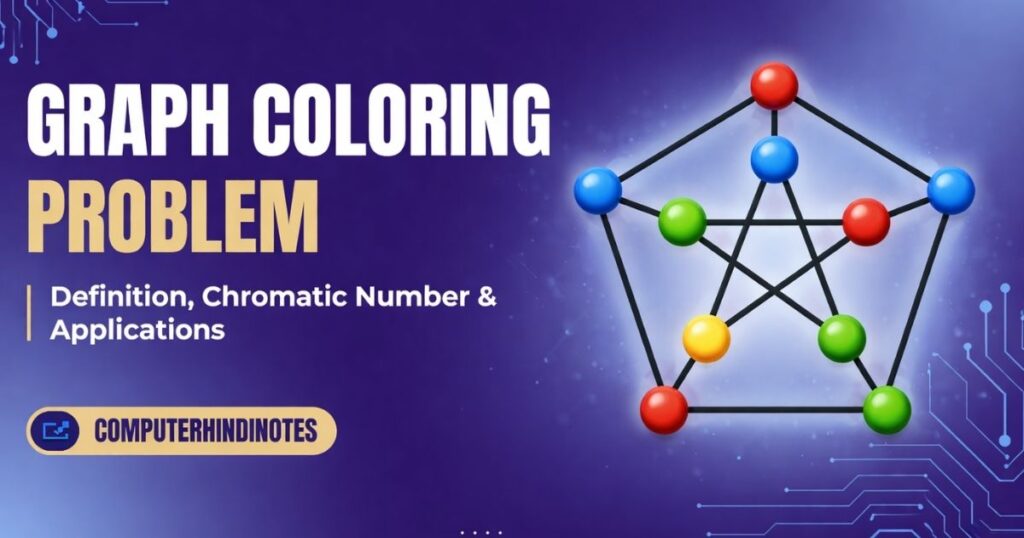
Graph Coloring Problem
Graph Coloring Problem वह computational problem है, जिसमें हमें किसी graph के vertices (nodes) को colors assign करना होता है इस condition के साथ कि :
- कोई भी adjacent vertices (जो सीधे edge से connected हों) same color न लें।
- हम minimum number of colors (Chromatic Number, χ) का उपयोग करना चाहते हैं।
Mathematical रूप में :
यदि G = (V,E) एक graph है जहाँ V vertices और E edges हैं, तो Graph Coloring का goal है :
Find a function f : V → C such that f(u) ≠ f(v) for every edges (u,v) ∈ E
जहाँ C colors का set है, और C minimum हो।
Chromatic Number (χ(G))
Chromatic Number वह minimum number of colors है, जो किसी graph को color करने के लिए required होते हैं।
Example :
- किसी graph को minimum 3 colors से color किया जा सकता है, तो
- Chromatic Number = 3
- Linear graph → χ(G) = 2
- Complete graph (Kn) → χ(G) = n
Why Graph Coloring Problem is Important?
(ग्राफ़ कलरिंग प्रॉब्लम क्यों महत्वपूर्ण है?)
Graph Coloring Problem केवल एक theoretical concept नहीं है, यह real-life decision making, resource management और conflict resolution के लिए एक powerful tool है।
Computer Science में इसे इसलिए अत्यधिक important माना जाता है, क्योंकि यह complex problems को simple color-based logic में convert कर देता है, जिससे problems को समझना और solve करना आसान हो जाता है।
इसका main objective minimum colors (Chromatic Number) का use करना होता है।
Example
- Exam Scheduling : Exam Scheduling में Graph Coloring का use इस बात को ensure करने के लिए किया जाता है कि कोई भी student की दो exams same time slot में न हों।
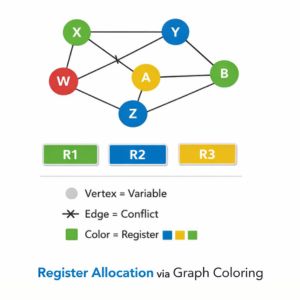
- Register Allocation in Compilers : Compiler में Graph Coloring का use CPU registers को efficiently allocate करने के लिए किया जाता है।
- Mobile Tower Frequency Assignment : Mobile networks में Graph Coloring का use frequency interference avoid करने के लिए किया जाता है।
- Sudoku Puzzle Solving : Sudoku puzzle को Graph Coloring Problem के रूप में model किया जा सकता है।
- Map Coloring : Map Coloring में Graph Coloring का use neighboring regions को अलग-अलग colors देने के लिए किया जाता है।
Types of Graph Coloring (प्रकार)
- Vertex Coloring : यह सबसे common type है। हर vertex को color assign किया जाता है, और कोई भी adjacent vertices same color नहीं लेना चाहिए।
- Edge Coloring : यहाँ edges को color assign किया जाता है, कोई भी दो edges, जो same vertex share करते हैं, same color नहीं ले सकते।
- Face Coloring : यह planar graphs के लिए होता है जहाँ हर face को color दिया जाता है और कोई भी adjacent faces same color नहीं ले सकते।
Applications (अनुप्रयोग)
- Map Coloring : Countries या regions को color assign करना जिससे adjacent regions same color न हों।
- Scheduling Problems : Exams, classes या tasks का schedule बनाना।
- Frequency Assignment in Wireless Networks : Communication channels या cell towers को assign करना।
- Puzzle and Game Problems : Sudoku या coloring puzzles में भी concept apply होता है।
- Resource Allocation Problems : Resources (जैसे machines, printers, rooms) को efficiently assign करना।

Advantages of Graph Coloring (लाभ)
- Efficient Resource Allocation : Graph Coloring resources (जैसे CPU registers, time slots, frequency bands) को efficiently allocate करने में मदद करता है।
- Conflict Resolution : Adjacent tasks, events, या nodes को अलग-अलग color देकर conflicts avoid किए जा सकते हैं।
- Optimized Scheduling : Scheduling problems में minimum number of time slots या shifts में task assign करना आसान होता है।
- Frequency Assignment in Networks
- Telecom towers या Wi-Fi channels को assign करते समय interference minimize होती है।
- Graph Coloring ensures adjacent towers same frequency use न करें।
- Map Coloring : States या countries को अलग-अलग color देना जिससे adjacent regions same color न हों।
- Compiler Optimization : CPU register allocation में variable lifetime conflicts कम हो जाते हैं।
- Helps in Problem Solving & Algorithm Design : Graph Coloring algorithms (Backtracking, Greedy, DSATUR) learning से logical thinking और algorithmic skills improve होते हैं।
Limitations of Graph Coloring (सीमाएँ)
- NP-Hard Problem (Computational Complexity)
- Graph Coloring NP-Hard problem है।
- Large graphs के case में exact solution find करना बहुत time-consuming हो जाता है।
- High Time Complexity
- Exact algorithms जैसे Backtracking का worst-case time complexity exponential होता है।
- Input size बढ़ने पर execution time तेजी से बढ़ता है।
- Not Suitable for Large-Scale Graphs
- Real-time systems या Big Data applications में Graph Coloring algorithms slow पड़ सकते हैं।
- Heuristic या Approximation methods का Use किया जाता है, जो हमेशा optimal solution नहीं देते।
- Memory Constraints
- Recursive algorithms (Backtracking) में stack overflow या memory issues हो सकते हैं।
- Large graph का solution store करना कठिन हो सकता है।
- Complexity in Real-Life Applications
- Real-world scheduling, frequency assignment, या map coloring में constraints बहुत complex हो सकते हैं।
- Multiple constraints handle करना Graph Coloring algorithm के लिए challenging हो जाता है।
- Approximation May Be Required
- Large graphs के लिए approximate या heuristic solutions use करनी पड़ती हैं।
- Optimal chromatic number हमेशा guarantee नहीं होती।